How Levanta measures true organic growth.
The data inside portfolio management systems is excellent for what it was built to do, which is portfolio performance. It was never built to answer a different question: how is an integrator or acquired practice actually growing, on its own steam, firm by firm. Answering that takes a layer on top. Here is how that layer works.
Why can't portfolio systems show organic growth?
They are designed to help advisors manage clients and portfolios, not to measure RIA firm health. A client moving money from an IRA into a brokerage account at the same firm looks like an outflow and an inflow. A new trust created for an heir looks like a lost client and a new one. Assets that arrive through an acquisition look the same as assets an advisor won this year. The aggregate number can be close, but the breakdown that drives management decisions, new clients versus lost clients versus net from existing, is missing.
The metrics hierarchy
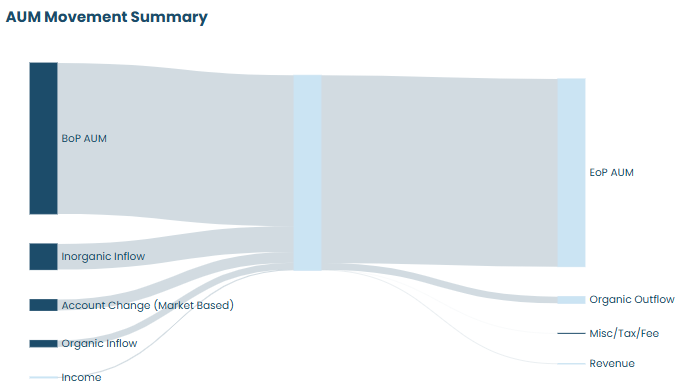
Levanta is designed to specifically deliver the KPIs rapidly growing RIAs run on: organic AUM growth and organic revenue. The platform meticulously enriches data at the lowest level, transaction data. Millions of records with multi-year look back, encoded deliberately rather than explained away.
Transaction-level tagging
Levanta begins at the atomic level, evaluating every transaction for every account. Our proprietary encoding system then enriches the data to identify, clearly:
Acquired assets are tagged as inorganic, money moving between accounts in the same household as a pass-through, and identical amounts moving between households in the same office as likely transfers for review. Distributions that are really wires into a private fund are caught rather than counted as departures, and a client is flagged as lost early, once a meaningful share of assets has left, so an advisor sees attrition while there is still time to act.
These metrics then cascade up to household, advisor, office, and firm-level views.
A human stays in the loop
The engine does the work, then surfaces a small number of edge cases for an analyst to confirm. On a book running well over a million transactions a month, that is roughly twenty to thirty items to review. You get accuracy without drowning in it.
Source-agnostic by design
Levanta is built to consume data wherever it lives. Orion and Salesforce are plug-and-play today. Other solutions, including other portfolio management and CRM solutions, onboard to deliver equivalent metrics, with the mapping work scaled to the source. The point is consistent definitions across every firm you own, even when each firm runs a different back end.
AUM and revenue, measured separately
Revenue correlation with AUM is not a given. An advisor can grow assets while revenue lags, or shrink low-fee assets while revenue rises. Moving a client from non-billable to billable, or up a fee tier, changes revenue without changing assets. Levanta can unpack thousands of fee schedules down to the household and account level, and measures organic revenue on its own, independent of organic AUM fluctuations.
Every number traces to the transaction
Because the work happens at the transaction level, every figure can be opened up and explained, to your team, your auditor, or your next capital partner. That is what makes the number defensible, and it is why a Big Four firm uses this enriched data in an audit of organic growth.